June 12, 2011

NBA Draft 2011: Enes Kanter and the 10 Riskiest Prospects

Photo Courtesy of nationofblue.comAt some point during the live telecast on June 23's NBA draft, the following phrase or something like it will be heard: "That was a risky pick right there."
Sometimes, the risks taken on draft day pan out, like when the Minnesota Timberwolves selected Kevin Garnett straight out of high school in 1995, making him the first high school player selected in the first round since Moses Malone; or when the Los Angeles Lakers traded Vlade Divac to the Charlotte Hornets on draft day in 1996, for a shooting guarding from Lower Merion, Pennsylvania named Kobe Bryant.
At other times though, the risk costs a general manager or team president his job, like when Michael Jordan made Kwame Brown the first pick in the draft for the Washington Wizards. Brown flopped, Jordan came back to play for two more years, and then was told the ownership stake he formerly had in the team would not be sold back to him upon his third retirement.
Risks are taken every year on draft day, and they will be this year as well. Whether or not they will pan out is anybody's guess, but the guys on this list are the ones most likely to hear that familiar phrase attached to their name on June 23.


1. Enes Kanter
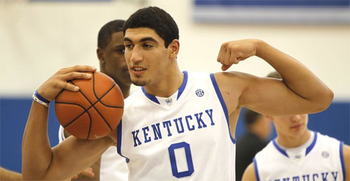
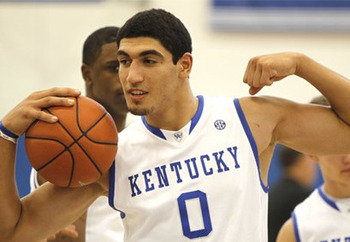
Photo Courtesy of nationofblue.comThis picture right here is one of very few of Enes Kanter in a Kentucky Wildcats uniform. Kanter was declared ineligible for the entirety of the season and never suited up for a single game during his time in Lexington.
Kanter, by all acounts, has as much talent in his seven-foot frame as any other player in the draft. But the team that selects him has to understand that by the time the presumed lockout is over, it will have been well over a year since Kanter last played in an organized game that counted.
At 19 years old, he's already very talented, and he has a lot of room to improve. However, pinning the hopes of a franchise on a 19-year-old with very little playing experience in the lead up to the draft has to cause teams a little concern. 


2. Jimmer Fredette

NEW ORLEANS, LA - MARCH 24:  Jimmer Fredette #32 of the Brigham Young Cougars shoots over Scottie Wilbekin #5 of the Florida Gators in the second half during the Southeast regional of the 2011 NCAA men's basketball tournament at New Orleans Arena on MarchJimmer Fredette is one of the more polarizing players in recent draft history.
There are those who swear he can contribute at the NBA level, either as a starter or off the bench. Others though, doubt that a player who for most of his college career had the ball in his hands all the time can make the transition to being a role player at the next level. 
The bigger (biggest) concern about Jimmer, though, is his defense. He was practically a sieve on that side of the ball during his tenure at BYU, and the guards at the NBA level are obviously much tougher to defend than those in the Mountain West Conference.


3. Bismack Biyombo

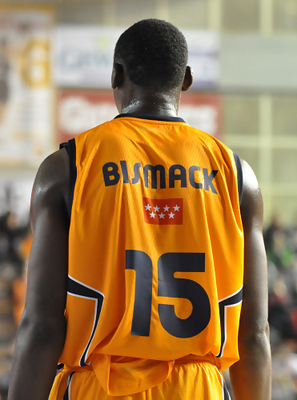
Photo Courtesy of slamonline.comBismack Biyombo is supposedly 18 years old. There are some who believe he could actually be as old as 23-26, and that is cause for concern. 
If Biyombo isn't really 18, then his raw talent isn't "potential," it's "lack of an offensive game."
Any time you're looking at drafting an international player, there also have to be concerns about culture adjustment, whether they can play the NBA style of basketball and whether they can handle increased playing time. 


4. Kemba Walker

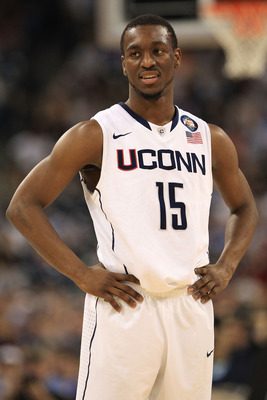
HOUSTON, TX - APRIL 04:  Kemba Walker #15 of the Connecticut Huskies looks on against the Butler Bulldogs during the National Championship Game of the 2011 NCAA Division I Men's Basketball Tournament at Reliant Stadium on April 4, 2011 in Houston, Texas. Kemba Walker is a shoot-first point guard. Unless he can be an efficient enough scorer like Derrick Rose, Russell Westbrook or Deron Williams, he won't be doing enough for his team in the NBA.
Walker is a great leader, but NBA point guards need to be able to get easy shots for their teammates. Walker struggled with turnovers a little bit at Connecticut and didn't have a great shooting percentage - he shot just 42 percent from the field and 33 percent from three point range.
If teams don't have to respect his jumper and can force him into turnovers, he can't be a starting point guard. 
At just 6'1", Walker may also struggle to defend bigger guards at the next level, and that is cause for concern as well.


5. Jeremy Tyler

Photo Courtesy of totalprosports.com
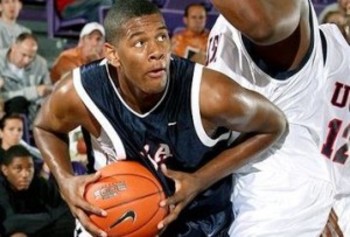
 One year after Brandon Jennings blazed the trail for high school athletes to play in Europe for a year instead of going to college, Jeremy Tyler took it to another level. Tyler decided to forego his senior season in high school and instead play two years as a professional.
Tyler didn't fare that well in his first international season but was slightly better this year. He's impressed in workouts so far, but his stock has dropped considerably from where it was when he was a high school junior.
He showed fairly bad decision making in this experience, and teams don't like bad decision making. Someone will take a flyer on Tyler either late in the first round or in the second round, but had he stayed in America, he might have gone much earlier on draft night.  


6. Jonas Valanciunas

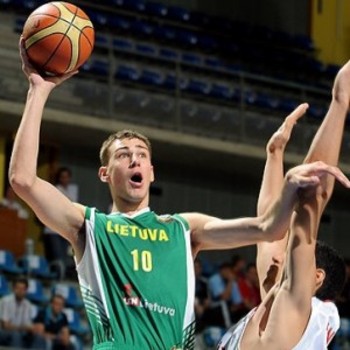
Photo Courtesy of eurohopes.com
 With a buyout that could be worth up to a reported $3 million, Valanciunas could have some trouble leaving his current team, Lietuvos Rytas. 
Because NBA teams can only pay up to $500,000 toward a player's buyout clause, Valanciunas could be on the hook for up to $2.5 million, and with a lockout likely looming, he may not be able to recoup that money in salary.
Valanciunas could then decide to stay in Europe, which is why it could be risky to take him. The longer he stays, the longer he is not contributing on an NBA roster. 


7. Josh Selby

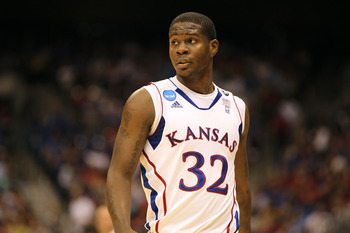
SAN ANTONIO, TX - MARCH 25:  Josh Selby #32 of the Kansas Jayhawks looks on during the southwest regional of the 2011 NCAA men's basketball tournament against the Richmond Spiders at the Alamodome on March 25, 2011 in San Antonio, Texas. Kansas defeated R Josh Selby came into Kansas as the highest rated point guard in his class but did not impress much in his only season in Lawrence. 
He was suspended for the first nine games of the year and then missed a few more with an injury before coming back and not contributing all that much.
Kansas was just fine without him for most of the year, and when he got back, he didn't really fit in their slow-paced big-man-centered offense. Selby has been working hard to prove that he can be a better player at the NBA level, but the concern about a drop off has to be there. 


8. Marshon Brooks

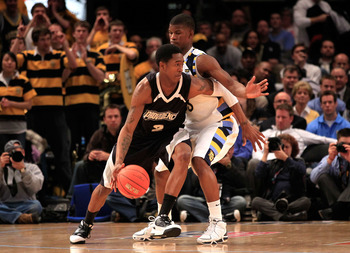
NEW YORK, NY - MARCH 08: Marshon Brooks #2 of the Providence Friars dribbles the ball against Jimmy Butler #33 of the Marquette Golden Eagles during the first round of the 2011 Big East Men's Basketball Tournament presented by American Eagle Outfitters at Marshon Brooks had an incredible four-year career at Providence, culminating last year with a 24.6 points per game scoring average, good for second in the country. That sounds like the exactly the recipe an NBA team would look for in a shooting guard.
However, the Providence teams that Brooks played on were simply not good teams. The Friars finished above .500 only once in his four years, falling to Miami in the NIT his sophomore season.
There's a lot to be said for how well Brooks played during his college career, but teams may worry that he is simply a guy who can put up impressive stats on a bad team. He'll have to adjust to not having the ball in his hands as much and becoming a complementary player. 


9. Charles Jenkins

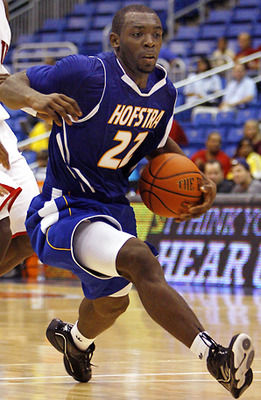
Photo Courtesy of Associated Press via sportsillustrated.cnn.com Charles Jenkins played at his college basketball at Hofstra.
The quality of competition at Hofstra is not even in the same stratosphere as the NBA.
Jenkins, like Walker and Fredette, is a score-first point guard who is used to dominating the ball. He'll have to make adjustments in the NBA in order to be successful, while adjusting to the much tougher competition. 


10. Jordan Hamilton

 Jordan Hamilton had a really impressive season for Rick Barnes and the Texas Longhorns this season, and at 6'9" and 220 pounds, he has the size to play either small forward or power forward in the NBA.

TULSA, OK - MARCH 20:  Jordan Hamilton #3 of the Texas Longhorns reacts at the end of their 70-69 loss to the Arizona Wildcats in the third round of the 2011 NCAA men's basketball tournament at BOK Center on March 20, 2011 in Tulsa, Oklahoma.  (Photo by T

The one knock on Hamilton is his shot selection, and NBA teams will just not tolerate a rookie getting too shot happy and always calling their own number.

There was a perception that Hamilton was a selfish basketball player who only looked for his own offense, and that will have to change as he moves forward. Hamilton is a highly skilled basketball player, and he knows it.

That plays to his advantage because he is supremely confident in his own abilities, but it can also work to his detriment if he gets too self-involved on the court. 

With the NBA Draft approaching, NBA Mock Draft season is here. Stay tuned to Bleacher Report for updated mock drafts, along with the latest NBA Draft news, analysis, rumors and predictions.


By Jared Dubin (Contributor) on June 12, 2011
bleacherreport.com

June 10, 2011

NBA draft position preview: big men

The list of the top big men in the 2011 NBA Draft is littered with names that even die-hard hoops fans may not be familiar with. Four of our Top 5 are international players, and the only American born player -- Tristan Thompson -- played just one collegiate season at Texas. Teams that go big at the top of the draft will be taking a big gamble. Because of the uncertainty at the top, teams looking for a post player in middle of the first round (like the Sixers picking at No. 16) could come away with a steal. Some more established and recognizable names will fall, while lottery teams bank on the potential of the players listed below.

1. Enes Kanter (6-11, 260, Kentucky)

Kanter sums up this year's crop of post players perfectly. The 19-year-old has all the tools, but good luck getting a handle on how he'll perform against NBA competition.

Unless you've followed Turkish basketball closely, chances are you haven't seen Kanter play. He spent last season sitting on the Kentucky bench after being ruled ineligible by the NCAA. He practiced everyday with the Wildcats, but practicing and game action are far different animals. Kanter is an extremely polished and athletic post player, that rare combination of size and skill.

He's a legitimate center at 6-11, and is able to step out and knock down the mid-range jump shot. Kanter also has the intangibles in his favor -- from all accounts he's very coachable and handled his frustrating season at Kentucky with maturity beyond his years. Look for Kanter to go in the Top 5, maybe as high as No. 3 to the Jazz.


2. Jan Vesely (6-11, 240, Czech Republic)

Like Kanter, Vesely isn't your typical big man. The 21-year-old is an extremely gifted athlete who can excel on the offensive end right away. Vesely is a high-energy guy who would be a great fit for a team that likes to push the tempo. Consistency is the question mark with Vesely, who some feel is a tweener at the small and power forward positions.

Vesely will rely on his athleticism and explosiveness from the jump in the NBA. He's billed as having a quick first step and being a great finisher around the rim. Vesely will need to improve his strength and play on the defensive end to fulfill his potential as a Top 10 pick. The Raptors could take a chance on him with the fifth selection.


3. Jonas Valanciunas (6-11, 240, Lithuania)

In the mold of his foreign counterparts, Valanciunas is able to run the floor and is very skilled with the ball in his hands. Valanciunas is considered by some to have the most talent and potential of any of the international players in this year's draft. At 21-years- old, he has significant European experience under his belt.

The knocks on Valanciunas are familiar: needs to add strength, improve his defense and consistency to be a factor over the course of an 82-game season. But his upside will be too much for a team picking in the Top 10 to turn down.


4. Bismack Biyombo (6-9, 240, Spain)

Biyombo was born in the Congo, but last played professionally in Spain. Where as other international players are known for their offense, the 20-year-old Biyombo is a defense-first big man. He's one of the top rebounders and interior defenders in the draft -- an elite level shot blocker with a NBA-ready body. His offensive game needs serious work, but whichever team drafts him will take the immediate dividends of his defense and wait for his offense to evolve.

Biyombo should go anywhere in the 8-13 range with the Pistons, Bobcats and Bucks being the frontrunners for his services.


5. Tristan Thompson (6-9, 225, Texas)

Thompson has a ton of potential. He averaged 13 points and eight rebounds as a freshman at Texas. Thompson's frame has all the makings of a terrific rebounder and shot blocker. He made great strides offensively during his time in Austin, a lefty who is a handful to defend on the low block.

Thompson, 20, attacks the offensive glass, taking advantage of his terrific leaping ability and nose for the ball. He'll get the bulk of his points early in his career in transition and on the offensive glass. Look for Thompson to go anywhere in the 10-15 range.

5 others to keep an eye on: Markieff Morris (Kansas); Kenneth Faried (Morehead St.); Donatas Motiejunas (Lithuania); Tobias Harris (Tennessee); Justin Harper (Richmond).

NBA draft position preview: big men
Thursday, June 9, 2011

Posted: 11 a.m.
By Sean Kane
E-mail Sean Kane at skane@comcastsportsnet.com
CSNPhilly.com Contributor

Dime Q&A: DeAndre Liggins Talks NBA Draft, Kentucky & Enes Kanter

The University of Kentucky basketball program under John Calipari saw five players get selected in the first round of last year’s NBA Draft, and this year has another expected lottery pick in Brandon Knight. However, one guy who hasn’t gotten the hype of John Wall, DeMarcus Cousins or Knight is DeAndre Liggins, who entered this year’s draft after his junior season.

Liggins has been Kentucky’s defensive stopper over the past two seasons, always assigned to guard the opposing team’s best player. While defense is what he’s known for, Liggins’ offensive game has shown signs of improvement since he first arrived at UK, as he has become a respectable outside shooter and has the athleticism to get to the rim. Had Liggins not been overshadowed at times by Kentucky’s bigger names, he would probably be much better known by those outside the Bluegrass State. I caught up with DeAndre at his Nets draft workout and talked about UK, defense and his draft prospects.

*** *** ***

Dime: You participated in the NBA Group Workout held here in New Jersey in May and got feedback from scouts and other NBA personnel on your game. How much did that influence your decision to stay in the draft?
DeAndre Liggins: When I first came here for the group workout I had a good showing, but I still felt like I had something to prove. Coming here helped me out a lot because I got to show scouts what I could do.

Dime: What did you hear from the scouts in New Jersey and before that workout that made you confident enough to stay in the draft?
DL: I heard that a lot of teams liked me but a couple of teams said that I needed to go back to school and needed another year to work on my game. I felt like I could show scouts that I could do more in workouts like these and improve my draft stock.

Dime: How hard was it for you to forgo your senior season at Kentucky, especially considering UK could be national championship contenders next season?
DL: It was hard. It was really hard thinking about that, but I was also thinking about my family, and my new child that just got here who’s four months old now. It was difficult not to go back, but I just had to stick with it (staying in the draft) and go with my heart.

Dime: What is your fondest memory of your time in Lexington?
DL: Definitely when I hit that three-point shot against North Carolina in the Elite Eight (that helped seal the game for the Wildcats to send them to the Final Four).

Dime: Describe what is was like to play in front of 23,500 fans every night in Rupp Arena and for UK. What did that mean to you personally?
DL: I was always nervous at the beginning of the game playing at Rupp, but once the jump ball went up I was calm. It’s a thrill to play in front of 24,000 fans every night.

Dime: UK fans are known as some of the most devoted in college basketball. What’s the craziest encounter you’ve ever had with a UK fan?
DL: When I was out one time someone wanted me to sign their sock (laughs).

Dime: At Kentucky you were known as a defensive stopper. Do you see yourself playing that role in the NBA as well?
DL: Yeah definitely. Defense is my bread and butter so that’s going to be what I’m known for in the League. But I’ve also got to improve my offense a little bit.

Dime: Who was the hardest player for you to guard in the SEC this past year?
DL: Probably (Vanderbilt shooting guard) John Jenkins. He is constantly moving and you’ve got to chase him around screens the whole time so it’s difficult to guard him.

Dime: You are one of the few people who got to see Enes Kanter compete this year in practice. Is he worthy of all the hype?
DL: Absolutely. Enes is a really hard worker, he’s a great competitor and he’s a beast on the boards, so he’s going to be a very good NBA player.

Dime: Coach Calipari has another star-studded recruiting class this year. What makes recruits want to play for him and for UK?
DL: Players see us making the Final Four or the Elite Eight and being on ESPN all the time. They see all the hype and love surrounding the program, anyone would love to come to UK right now.

Dime Q&A: DeAndre Liggins Talks NBA Draft, Kentucky & Enes Kanter
By Daniel Marks
College, NBA, NBA Draft / Jun 8, 2011 / 2:30 pm
dimemag.com

Enes Kanter Projections

All Wolves fans know that with David Kahn, where there's draft rumor smoke, there's probably fire.  Since multiple sources have reported the Wolves are interested in Enes Kanter, I decided the other day to try to talk myself into the pick.  Since I'm not a professional scout, like many posters on Hoopus I really primarily on draft sites and quantitative data to get a feeling for prospects, and the oft-repeated problem with evaluating Kanter this way is that these sites have no data about his performance.
It turns out, however, that there ARE some data about Kanter's performance in competitive basketball games.  In particular, at fibaeurope.com, we can find 17 games and 524 minutes worth of data about Kanter's performance in the 2008 and 2009 European Men's under 18 championships.  His performance there was very good: Per 36 minutes, Kanter averaged about 22 points on 0.627 TS%, 18 rebounds, 1 assist, 1.5 blocks, 1 steal, 2 fouls and 3 turnovers.  Considering the level of competition, what do these numbers mean, and do they have any relevance to the NBA?

Star-divide

First: Kanter wasn't just good in these 17 games, he was dominant.  His overall raw production is better than any other player in the online history of the tournament - fibaeurope has box score stats for the top division going back to 1996 and no player (out of 1,874) has posted a higher Win Scores / minute than Kanter did in 2008.  The next closest player to Kanter's 25.4 WS/40 that year was Valanciunas in 2009 and 2010, with 23.8 and and 24.2, respectively; and besides Kanter's 20.6 in 2009, only two other players have posted a WS/40 above 20 (E. Lorbek and M. Raduljica, with 21.9 and 20.5, respectively).  That's pretty dominant.
Fine, you say, but any player who can play in the NBA should dominate against this level of competition.  Well, it turns out that 15 players 6'9" or taller did play in the tournament (during the period that stats are available) and later log minutes in the NBA: Alexis Ajinca, Andris Biedrins, Omri Casspi, Semih Erden, Pau Gasol, Marc Gasol, Victor Khryapa, Andrei Kirilenko, Kosta Koufos, Maciej Lampe, Ian Mahinmi, Dirk Nowitzki, Johan Petro, Darius Songaila, and Ronnie Turiaf.   None of them dominated the way Kanter did.  But more importantly, this gives us the opportunity to see if we can learn something about Kanter's likely NBA performance.

Forecasting Kanter's NBA Stats

Using the data from FIBA and BB-ref career per 36 averages for each of the 15 players above, I produced the following prediction for Kanter's TS% and Per 36 numbers:

TS%PTS/36REB/36STL/36BLK/36AST/36TOV/36PF/36
0.57616.810.11.21.61.42.43.8

Scoring - True Shooting Percentage and Points

Here's a plot of each player's TS% in the under-18 championships versus the players TS% in the NBA.  Two "outliers" were removed: Erden, whose TS% increased dramatically (from 0.44 to 0.59) due to a drastic reduction in usage; and Lampe, who had the most extreme drop in TS% in the data set (from 0.54 to 0.44) for no reason that I could see.


The best-fit line (shown in the image) has an r^2 of about 0.4, but a p-value of 0.04, so U18 TS% is statistically significant but only explains about 40% of the variation in NBA TS% among this sample.  In any case, if you plug in Kanter's 0.627 TS% to the linear model found by regression, you get a predicted NBA TS% of 0.576.

The regression for points has an even worse r^2:


I think the relatively low r^2 in both of these models can be explained primarily by variation in usage: most, but not all, of these players had high usage in the U18 tournament but they had a wider range of usage in the NBA. Most of the points above the best-fit line represent players with consistent usage between the two leagues, while it is more of a mixed bag below the best-fit line. Since I would expect Kanter to have high usage in the NBA (due to being drafted early) I think the model gives a reasonable prediction for his TS% and scoring.

Rebounds 

Kanter's 18 Rebounds per 36 minutes is off the charts both among the players in the NBA sample and all players with at least 40 minutes in the U18 tournament since 1996 - the next highest is Valanciunas with 15.  So the model may be underpredicting his rebounds/36 at 10.1.  (This model excludes one outlier, Biedrins, who somehow saw his rebounds/36 increase by 50% - from 8 to 12 - between the U18 tournament and the NBA, despite playing his first season in the NBA only a few months after playing in the tournament)

Assists, Steals,  and Blocks

Several of the older players in the sample appeared to have no blocks data (or just had really bad luck collecting no blocks in 100-200 minutes across 7-9 games) but otherwise these are pretty straightforward translations with pretty good r^2 values:


To show better detail, I truncated one point from the Steals plot: AK47 is way off to the right at 5.4 steals/36 in U18 play. (His NBA STL/36 of 1.6 almost perfectly fits the model)


Kanter's numbers are right  around the median for these stats: they don't look great or terrible.  (Although given his high usage the AST/36 numbers are a little low.  He might be kind of a black hole)


Turnovers and Fouls

Linear models for TOV/36 and PF/36 had a low r^2, mostly because there does not seem to be much variation between the players in the sample at the NBA level: they all had between 1.6 and 2.4 TO/36 (the r^2 for the "best fit" line here was 0.02) so to be safe I went with the maximum value among the NBA players.  The model for PF/36 looks like this:


Like TS%, turnovers and, to a lesser extend fouls, will depend on usage.  Since Kanter already had a high usage rate in the U18 tournaments and we would expect him to have a high NBA usage rate based on being picked early in the lottery, his PF/36 may slightly exceed the 3.8 predicted by the model.

Exploring Sample Size

While 500+ minutes and 17 games is not exactly a small sample, it's not huge either; and 15 players are a pretty small set to build a translation model from.  In order to estimate the potential for error in the model due to sample size, I used resampling ("the bootstrap") to compute confidence intervals.  The 10th percentile of predictions for each stat came out like this:

TS%PTS/36REB/36STL/36BLK/36AST/36TOV/36PF/36
0.53013.59.20.81.31.42.43.9

What does it mean?

In resampling, the 10th percentile of predicted WP48 for Kanter was 0.14 - so roughly there is a 90% chance of producing a higher prediction, depending on randomness in the sample. That is a very good center, similar by Berri's metrics to players like Al Jefferson (WP48 of 0.127) and Elton Brand (0.146).  Especially given Kanter's dominance on the boards, I think he is likely to produce along the lines of these two players, and that is reasonable, if not exciting, production for a non-superstar pick.  I'm not sure if Kanter is a good fit for the wolves, especially because of rumors of his defensive inadequacy, but he seems like a good value generally.

Of course, these data are old.  More recent observations of Kanter seem to have been mixed, which is why it is more important than usual to combine scouting data with stats in this case.  Finally, there is one cautionary tale in the U18 data set:

PlayerTS%PTSREBASTSTLBLKPFTOV
Kanter0.62722.018.21.11.21.72.23.1
Koufos0.54127.413.40.41.43.61.7
1.9
 
Enes Kanter Projections
by hopps on Jun 8, 2011 4:12 AM CDT
canishoopus.com

June 7, 2011

2011 NBA Draft Rumors Featuring Kemba Walker And Enes Kanter

Ridiculous Upside looked a bit different on Monday as the 2011 NBA Draft took a backseat to some rumors I've been hearing regarding the NBA D-League (my first love). For those that don't love the Development League as much as myself, however, we're back to draft coverage today.
Kemba Walker was said to be ducking Jimmer Fredette when The Hoops Report first reported it (LOL), but ESPN's Chad Ford went on Twitter and cleared up the reason Walker changed his workout date for the Sacramento Kings. According to Ford, Walker is working out for the Toronto Raptors on Tuesday and the Detroit Pistons on Wednesday so his agent didn't the former Connecticut point guard working out three days in a row.

For the conspiracy theorists out there, Walker will work out against Fredette on June 15 for the Utah Jazz according the Salt Lake Tribune.

The biggest injury news for this draft class is regarding the earlier report that Colorado's Alec Burks dislocated his shoulder, but it turns out that it isn't as bad as it was originally reported. Burks, one of the best wing prospects in this draft class, had an MRI showing that the injury is better than it sounds allowing him to return to workouts later this week according to Yahoo! Sports' Marc Spears.

Enes Kanter was also said to have injury issues (with his knees, not his shoulder), and even though those rumors were cleared up, the Turkish big man is still facing some issues leading up to the June 23 NBA draft date. Jonathan Givony of Draft Express got his hands on some game footage of Kanter from prep school and wasn't impressed. Check Givony's full Twitter feed for more details.

Speaking of Kanter, he will workout with the Cleveland Cavaliers on Tuesday in what will likely be one of his only group workouts since he doesn't even plan to meet with the Washington Wizards.

The Portland Trail Blazers don't like pre-draft workouts as much as they used to (and I don't blame them). If a team watches enough during the year,

Last, but not least, the New York Knicks decided to move Donnie Walsh down a couple of notches and into a consultant's role. That won't have any affect on the Knicks' draft plans, however, according to Chad Ford. Ford also believes the Knicks have narrowed their interests to Fredette, Klay Thompson, Josh Selby, Marshon Brooks and Kenneth Faried, for what it's worth.

2011 NBA Draft Rumors Featuring Kemba Walker And Enes Kanter
by Scott Schroeder on Jun 7, 2011 6:00 AM EDT in NBA Draft 2011
ridiculousupside.com

Enes Kanter – Draft Profile

This week will be the final profiles of lottery picks. Starting next week, Mo and I will profile potential second round picks. I will also list the top 20 players that I think will be most successful. My top six are:

#1 Kyrie Irving – I see no reason to disagree with the majority. Point guard is an important offensive position and Irving is the best in this or next year’s draft.

#2 Derrick Williams – I think he can be an NBA SF.

#3 Enes Kanter – See below.

#4 Jonas Valanciunas – I would consider picking Valanciunas over Kanter, drafting him on the condition that he works with a Cavs provided strength coach and shooting coach. In a year, he can come from Europe with 15 lbs of added muscle and a reliable 18 footer.

#5 Brandon Knight –He’ll eventually be a quality PG in the NBA.

#6 Alec Burks – He’s a great scorer and rebounder with good size and athleticism for a shooting guard. PER, offensive rating, on-court / off-court numbers are all impressive and he doesn’t turn 20 until July. I like that he was the #33 ranked SG in the class of 2009, now he’s a lottery pick. I give extra credit for players with late growth spurts who are rapidly improving. With improved shooting, he should be excellent.

Now, for my #3. Kanter is meeting with the Cavs this week and is a likely pick at #4.


Enes Kanter


Height: 6’ 11.25”

Weight: 259 lbs

Position: PF / C

Age: Turned 19 in May

Summary: Enes Kanter is the mystery of the high lottery. He was a basketball prodigy, dominating Europe’s youth tournaments and playing in the Euroleague as a 16 year old. Due to NCAA eligibility problems, he has not played competitively in over a year. He is projected as a top 4 pick.

Basketball Bio: Kanter first made his name in European youth tourneys. At age 16, his 15 rebounds per game earned him first team all tournament at the 2008 European U18 championship. The next year he dominated; averaging 18.6 points and 16.4 rebounds while winning MVP and leading Turkey to 3rd place. At 16, he was signed by Turkish basketball power, Fenerbache Ulker, and played in 11 professional games, including 4 in the Euroleague. This brief professional stint proved more critical to Kanter’s future than the 2 ppg and 1.5 rpg would indicate. Kanter turned down large European contracts and decided to move to the United States to play college basketball. He enrolled at Stoneridge Prep in California, playing one year of high school. He committed to play at Kentucky, but was ruled ineligible by the NCAA due to his brief professional play. He has spent the last year practicing and training with the Kentucky basketball team.

Skill Overview: Kanter has the size to play power forward and center in the NBA. He measured as the second tallest player at the combine and was in great shape, weighing 259 lbs with only 5.9% body fat. Possessing the size & strength to match up with most NBA centers, he plays physically in the low post and is not afraid of contact. He is a strong competitor, staying active on the boards and defensively. His activity level, positioning, and great hands make him a dominant rebounder. Kanter has exhibited a range of offensive talents; displaying solid footwork and finishing moves in the post, while also demonstrating shooting range out to the college three. Kanter has a good attitude and works hard at improving his game.

Kanter is an average athlete. Of the seven players over 6’10” at the NBA combine, Kanter had the second lowest vertical jumping and wingspan. Of the “tall” players, he was 2nd in the speed drill and 3rd and 4th in agility drills. Kanter has been described as “non-explosive”, and the combine athletic tests support that. Kanter’s biggest negative may be his limited history of competitive basketball, with almost no experience against players older than 18. The game is about to get a lot faster; will Kanter’s rebounding and offensive games thrive against players as big and athletic as him? Will his defensive rotations look as impressive when the guards and ball are moving at blazing speed? No one can definitively answer these questions.

Additional Info: The other forum where Kanter impressed was the Nike Hoop Summit in April 2010. At this annual high school all-star game, Kanter nearly lead the internationals to victory over a United States team featuring Kyrie Irving, Brandon Knight, Jared Sullinger, and Harrison Barnes. Kanter scored 34points, a new event record, and grabbed 13 rebounds in 24 minutes. He was great on the offensive glass and scored with post moves, jump shots, fast breaks finishes, and even on drives. Very impressive, but it was a high school all-star game, so it’s hard to tell how impressive. The US front line was not outstanding; consisting of Sullinger, Patric Young (3.4 ppg & 3.8 rpg at Florida State this year), Leonard Myers (2.1 ppg and 1.3 rpg at Illinois), and Terrence Jones (more SF than PF). Defensive rebounding wasn’t a priority in the game, as each team collected 17 offensive boards. Almost half the missed shots were rebounded by the offense.

Kanter is considered a good shooter, however again there isn’t a lot of actual data supporting this. High school highlights show him hitting high school three’s, but how many were missed? That info isn’t readily available. He shoots well during a workout, but what about with an NBA defender rapidly closing on him? Combine shooting tests were a mixed bag. Of the 16 players that performed the big men drills, he was in the top third in two drills and the bottom third in two. He was 5 of 12 for the timed shooting drill of 35 seconds shooting 15 – 18’ jumpers.

As an offensively skilled big man; comparisons include Al Horford, Kevin Love, or Carlos Boozer, and I won’t debate this. I have him rated #3 primarily because people who are a lot smarter than me have him rated highly. When he has played, he has been dominant against his age group. Hopefully the potential shown in the opportunities available to him will transfer to the NBA, both offensively and defensively.

Enes Kanter – Draft Profile
June 6th, 2011 by Kevin Hetrick
cavstheblog.com

June 3, 2011

The 14 Most Pressing Draft Questions

With the draft less than a month away, teams, players and fans are starting to get antsy. This particular draft, with its bevy of mysterious (and elite) foreign talents, odd disbursement of picks (the Cavs are the first team to hold multiple top four picks since 1983), and alleged lack of superior talent, has presented a great deal of questions that need answering so that we can start to make sense of the puzzle. Just as the 14 lottery picks often define the draft, these 14 questions encapsulate the most pressing issues concerning the draft, and what will eventually come to define it.

14. Which unproven prospect will a team most likely reach for?

The obvious answer might appear to be Bismack Biyombo, though the Congolese center has actually proven himself more than many of this year’s most popular high risk/high reward prospects. Biyombo averaged 2.3 blocks in just 17 minutes for a top international team this past season and recorded the first ever triple-double at the Hoops Summit. Fellow raw talents Travis Leslie, Josh Selby, Jereme Richmond and Cory Joseph, in comparison, have done nothing, but their potential can’t be totally ignored. After a terrific combine, Selby usurps Leslie as the player most likely to get the most looks from teams picking anywhere from the early teens right on down to the early forties. Selby, as many predicted, was a workout wonder: his 42” max vertical leap was matched only by Iman Shumpert, and ranks as the ninth highest jump recorded in the history of the combine. At 6-3/195, Selby measured as big as could have been expected, staking his claim as the most physically gifted PG prospect. One team in the first round will doubtlessly turn a blind eye to his horrible freshman stats with the hope that he can fulfill his potential.

13. Will the Knicks reach for a potential franchise PG or take the best player available?

You can always count on the Knicks’ faithful to put on a good show immediately after the team’s selection is announced, and for them to be reliably displeased with whoever they take; unless Brandon Knight falls to them at 17, you can count on a fairly entertaining reaction. But from a serious basketball perspective, this pick is extremely important considering the Knicks’ massive potential. With no NBA-ready centers expected to be available at 17, the Knicks will likely take a PG or a versatile scorer who can help out immediately, though they’ll also give a couple defensive specialists, especially Kenneth Faried, a hard look. If the Knicks are to go with a PG, they would likely be choosing between Darius Morris and Josh Selby, with Morris being the much more sensible pick. Morris has amazing size (6-5/190) and the pass-first mentality that a team with Amare and Carmelo requires. However, the PG that they draft would be expected to become their franchise floor general, and there might not be one worthy of that responsibility. It will be very hard for them to pass on Jordan Hamilton, Klay Thompson or Marshon Brooks, as their depth was decimated in the Carmelo trade.

12. What is Enes Kanter’s game, and where does he fit?

[Player; Enes Kanter] has just about all the qualities scouts look for in an elite center prospect: size (6-11/259), post moves, good form and range on his jumper, satisfactory athleticism, and a willingness to bang in the post. The Cavs cannot justify taking him number one because the consensus is that he simply isn’t as good a prospect as Derrick Williams or Kyrie Irving. The Wolves would love to nab a franchise center, but Kanter could be seen as too similar to Kevin Love, a skilled big but lacking in defensive attributes. The Jazz could ultimately pass on him in favor of Brandon Knight because of their loaded frontcourt. Kanter plays like a true center but won’t hesitate to take the open 16-footer, making him a perfect fit for the Wizards, a team he has expressed interest in playing for. But they already have an athletic, defensive-minded center in JaVale McGee firmly in place. A good center is the rarest player in the NBA right now; you’d think there would be a greater premium on a guy with Kanter’s size and skill.


11. Which franchise is under the most pressure to hit a home run?

Just a couple years ago, crazed Pistons fans were rocking the Palace of Auburn Hills and leading the league in attendance as the team tried to earn a seventh consecutive conference finals berth. This past season, the Pistons struggled to win 30 games, almost deserted their coach, and finished 18th in the league in attendance. The Cavs are still the team most in need of a miracle, but with the first and fourth picks, it will be hard to criticize them. The Pistons, on the other hand, are set to pick eighth, a relative no man’s land where the can’t-miss prospects will be gone and the guessing begins. They have glaring holes at point guard and center, and a major hole at the swing, with Prince and McGrady set to become free agents. With no worthy point guards expected to be on the board, look for them to target a nice mix of solid bets (Kawhi Leonard), good fits (Tristan Thompson), and extremely high risk/extremely high reward big men (Biyombo). In whichever direction they choose to go, the Pistons will need to make the most of their pick, because should they swing and miss, they could be handicapped for years.

10. Who benefitted the most from his measurements?

USC power forward Nikola Vucevic, who measured 6-11.75 in shoes when he was thought to be 6-10, is not the type of player who will rocket up mock drafts because scouts are now confident that he will be able to play his position and not be consistently outmatched defensively. No, Vucevic now looks like an entirely different player. Vucevic was very much a classic Euro big man in his time at USC, showing off a terrific jump shot to complement a reasonably well-developed post game. With a 7-5 wingspan, Vucevic is as big as Greg Oden and is no longer seen as a tweener, but a legit big man who can get his shot off whenever he wants. He also weighed in at 260, a full 20 pounds more than anticipated, and with only 6.1% body fat, qualifying him as a legit center. Granted, Vucevic tested extremely poorly in the athleticism portion of the combine. Considering this draft didn’t have a single center who played college ball in the US and was projected to be a first round pick, Vucevic could see his stock soar from mid-late second round to late first.

9. Who will turn out to be the best scorer at the next level?

The most glaring indicator of a subpar draft class is the absence of a player that will be expected to average 20 points per game in the pros. Derrick Williams and Kyrie Irving might have the best odds, but because Irving is a pure point guard and Williams has a more unconventional game (and won’t have the freedom he had at Arizona), the field is wide open. With his much-improved shot, Kemba Walker demonstrated his ability and willingness to take over games. If he isn’t as overmatched as some think he might be, Jimmer Fredette could easily be the best scorer. Alec Burks is an incredibly athletic and smart slasher with the potential to average 20 points once his jumper catches up, and Providence’s Marshon Brooks, who scored 52 points in a Big East game, was compared to Kobe by his trainer, Tim Grover (who’s trained Kobe). While I would put my money on Derrick Williams due to his ability to get the stripe with uncommon ease, I also wouldn’t bet against Jordan Hamilton. The former Longhorn possesses the most well-rounded skill set of any scorer in this class, improved immensely as a sophomore (10.6 points to 18.6 points), and at 6-8 can easily play either of the wing positions.

8. Is Derrick Williams a potential franchise player?

His explosive game at times resembles Blake Griffin's, he can play inside and out, shoots over 50% from three-point range, is a relentless competitor, and as his sophomore year indicated, he has a very high ceiling. But that might not even be enough. Despite his offensive efficiency, Williams is not seen as the type of player who can routinely score 25 points and shoot his team to victory, and despite his determination and effort, he’s not yet an elite defender. He’s caught between two positions, a trait that franchises don’t necessarily love when they’re pegging a future leader, but shouldn’t he still at least be eligible to be considered a potential franchise player? Williams could average 20 points and 10 rebounds at the small forward position and change a team’s outlook with his motor and energy while he willingly does all the little things. The Cavs will certainly wrestle with the idea of Williams being a franchise player, which brings us to the question…

7. Would the Cavs be better off taking Williams with the first pick and a PG with the fourth?

Kyrie Irving is believed by many to be the best prospect in the draft, and he appears pretty confident that the Cavs will take him with the top pick. While Irving may be the best prospect available, the Cavs are in a unique position, holding not just the first, but also the fourth pick in the draft, and by taking Williams first overall, they could nab a more talented player with the fourth pick. If they take Irving first, they will likely be forced to target players such as Jan Vesely, Kawhi Leonard and Jonas Valanciunas with their next pick. However, if they were to take Williams first, they could grab a point guard (Knight, if available, or Walker) or one of the two big men they’re targeting, giving them more flexibility and the opportunity to take the two best players possible. Neither Kanter nor Valanciunas is a sure thing, and even Irving has question marks. For a team that has no room for error when it comes to drafting, taking Williams first and watching the chips fall might be the smartest move.

6. Does Kenneth Faried have the size to fulfill his potential at the next level?

The most aggravating and disappointing aspect of the draft is the number of highly skilled and determined players who are passed up because they’re too short by NBA standards. Morehead State’s Kenneth Faried is the very player that would usually undeservedly fall to the second round, but the numbers he posted in college are too incredible to ignore. Still, the question remains, does he have what it takes to be the next Dennis Rodman? Or even the next DeJuan Blair? Or is he the next Luc Richard Mbah a Moute? ESPN’s Fran Fraschilla boldly claimed that if Faried was 6-9, he would be the top pick in the draft. A stretch considering all he does is rebound. The sad truth, however, is that Faried is just 6-7 in shoes, and with little offensive game to speak of, teams will have to hope that he’s as tough as advertised. Faried did measure a very respectable 9'0 standing reach. He is the best rebounder to enter the draft since Paul Millsap, and a great all-around defender to boot, but in the much bigger, stronger, and faster NBA, he will be tested like no other prospect in this class.

5. Who is the top Euro prospect?

Excluding those who have not spent the entirety of their basketball-playing lives in Europe (namely Biyombo and Kanter), there remains a distinct trio of extremely intriguing prospects that all stand around the same height and all play a very different style: The 7-0 Donatas Motiejunas (Lithuania), the 6-11 Jonas Valanciunas (Lithuania), and the 6-11 Jan Vesely (Czech Repulbic). Though they’re all about the same size, they’re hardly similar. Motiejunas isn’t the greatest athlete, but he has arguably the most well rounded skill set, with a beautiful jumper, excellent speed and developing post game. Valanciunas is the rare European big that’s legitimately tough; he's not adverse to banging down low, is great around the basket and runs the court well. Vesely is the best run/jump athlete and the most versatile of the bunch and is similar to Andrei Kirilenko. Vesely is possibly the most intriguing of the bunch, Valanciunas is considered the best long term prospect but the furthest away while Motiejunas has the most offensive potential.

4. Is Bismack Biyombo the next Saer Sene or the next Serge Ibaka?

The Sonics selected Saer Sene with the 10th overall pick in 2006, simply because he was a legit 7-footer with an inhuman 7-8 wingspan. He could touch the rim without leaving his feet. They expected him to become a great shot blocker. He had only started playing basketball in 2003, and his NBA career spanned just 47 games. Serge Ibaka was slightly more well known when he was drafted by the Thunder late in the first round, and he’s since morphed into the league’s best shot blocker and the starting power forward for a team that nearly won the West. Biyombo is 6-9 with a similarly inhuman 7-7 wingspan and an extremely weak offensive skill set, and those picking in the lottery want to know who he’s more likely to compare to. Though he’s more comparable to Sene from a skills standpoint, all signs point to him being more like Ibaka. Not only does Biyombo have a more mature game than Sene, he has shown a motor that Sene was missing and had a legit impact playing in 10 games in the same Spanish league that Ibaka came from. There’s a chance he could still be a bust, of course, but only because he may end up being taken to high and expected too much from.

3. Is the draft as weak as many are saying?

When the 2011 NBA draft is mentioned, the first adjective that comes to mind is, probably, “weak.” That’s what so many scouts are saying, and it’s a hard claim to refute. Still, when the dust settles a few years from now, there’s a chance that it might not come to be viewed as such. It’s hard to recall a draft as rich with elite foreign talent, as we could see five international players taken in the lottery. If they’re all as good as advertised, that in itself would qualify this draft as being uniquely rich in talent. Then again, maybe that is a product of such a weak college crop. Depth is also a key factor in evaluating the strength of a draft, and this group is more solid at the bottom than it’s been given credit for, with every post-lottery prospect considered somewhat equal through the end of the first round. In all likelihood time will confirm that this is a relatively weak group, though every one of the 60 prospects that turn pro on June 23 might have something to say about that.

2. Does Kyrie Irving deserve to be called the undisputed top pick?

We’ve been spoiled in recent years, we really have. From Greg Oden to John Wall, each of the last four drafts have promised not just a superstar, but a potential Hall of Famer at the top spot. Possible #1 pick Kyrie Irving is unfortunate for having to follow these enormous talents, yet even considering how we have been conditioned to feel about top overall picks, Irving is not a legit #1 guy. But he’s something almost as good: a legit #2 pick, in almost any year. Irving probably will never start an All-Star game, but a sample of recent second overall picks suggests that he’s not necessarily overrated. The list reads like this: Darko Milicic, Emeka Okafor, Marvin Williams, LaMarcus Aldridge, Kevin Durant, Michael Beasley, Hasheem Thabeet, Evan Turner. Irving could stand to be less cocky about what he believes his current standing to be, but he has the size and skill set to make a dent in this point guard’s league and should definitely be better than at least half of those aforementioned silver medalists.

1. What will David Kahn do?

From drafting three point guards in the first round, to proclaiming Darko Milicic to be equal to Chris Webber and the best passer he’s ever seen, to suggesting that the lottery might be fixed, Timberwolves GM David Kahn has achieved cult status among basketball fans, many of whom don’t think very highly of him. With his knack for making wild claims and obsessively collecting point guards, he’s the most unpredictable GM in the game, and therefore one of the most dangerous. This year, after losing out on the top pick, immediately discard your expectations on draft night. The Wolves likely cannot take the second best prospect, Derrick Williams, because he plays the same position as Beasley and Love (and the 21-year old Anthony Randolph, who averaged 11.7 points in 23 games with the Wolves). The Wolves are openly dangling the pick, but just what Kahn might demand, or give it up for, redefines unpredictable. The Wolves want veteran help, so expect him to pursue legitimate stars. Don’t, however, expect any of it to make sense.

The 14 Most Pressing Draft Questions
By Sam_Littman
Thu, 06/02/2011 - 11:36am
nbadraft.net
Agent Expects Kanter to Go in Top 3 Picks

Enes Kanter remains a mystery to the majority of American basketball fans, but his agent expects the Turkish star to go in the top couple picks of the June 23 NBA Draft.

“We expect him to go within the first two picks,” Mike Naiditch, an NBA agent who is close to Kanter’s agent, Max Ergul, said Wednesday by phone. “We expect him to go in the top 2, maybe 3, but we don’t think he’s going to go past that.”

Said ESPN analyst Fran Fraschilla: “He’s going by the fourth pick. I think he could go as high as 2. The reason he won’t go 1 is because Cleveland won’t want to make a mistake on a foreign guy.”

Conventional wisdom has Duke utahpoint guard Kyrie Irving and Arizona forward Derrick Williams being taken first and second by the Cavaliers and Minnesota Timberwolves, respectively.

The 6-foot-11 Kanter will begin his workouts Friday when the Utah Jazz, who own the No. 3 pick, come to Chicago to watch him work out at Tim Grover’s Attack Athletics. The Toronto Raptors, who have the No. 5 pick, will watch Kanter Monday in Chicago.

On Monday evening, Kanter, 19, will fly to Cleveland for a workout there Tuesday. The Cavs own the No. 1 and 4 picks.

Minnesota will host Kanter June 16-17, following the EuroCamp in Treviso, Italy.

The Washington Wizards, who pick No. 6, have also expressed interest.

Kanter, who was ruled ineligible at Kentucky this past season because of his professional history in Turkey, has drawn comparisons to Dwight Howard, Dennis Rodman and Al Horford.

“He’s more the Turkish Dwight Howard,” Naiditch said. “Kanter has the ability to face the basket and shoot it. The thing with Kanter that’s just amazing to me is that he has a knack for the ball. He’s so smart and he knows where the ball’s going to be. He’s going to rebound like Dennis Rodman. He doesn’t look like Dennis Rodman, a little different hairstyle, but the kid has a knack for getting rebounds. When it’s all said and done that’s what’s going to set him apart at first.

“And then as he matures, his offensive game will develop to the point where it could be as good as his rebounding game.”

Fraschilla, the ESPN analyst who specializes in international players, has a different comparison for Kanter.

“The best analogy I can you give in the NBA right now is Al Horford,” Fraschilla said by phone. “If there was an arrow up or down, Enes’ arrow coming into this next four weeks is up.”

After measuring 6-11 1/2 in shoes and 262 pounds with 5 percent body fat at the Chicago Predraft Camp, Kanter excelled there.

“He runs the floor great, he shows well at the combine,” Fraschilla said.

“His track record, while limited, the one performance people take away from is the Nike Hoop Summit performance where he was the dominant player on a court with Jared Sullinger, Harrison Barnes, Perry Jones and Terrence Jones.”

Kanter exploded into the basketball consciousness at that event in 2010 with a 34-point, 13-rebound performance despite a bad back.

Kanter was declared ineligible at Kentucky, and thus hasn’t played a competitive, five-on-five game in more than a year.

“When the NCAA made me ineligible, I just didn’t give up,” Kanter told ESPN’s Chad Ford in Chicago. “I talked to Coach Cal [John Calipari] and I said i just wanted to help you. I just try to help my teammates and I just try to help Kentucky.”

After working out at Attack Athletics in 2010, Kanter returned there this year after school ended and has been working on his offensive game.

“I hate to lose and I like to play post moves and rebounds,” he told Ford. “Right now I’m working on my face-up game. I want to be a power forward, too. I love to play tough game. I think that’s my tough game.”

That game could have Kanter going within the top few picks in the draft.

“I don’t think he’s quite as much as a secret as people think,” Naiditch said. “He’s just not as conventional as a college player.”

Agent Expects Kanter to Go in Top 3 Picks
By Adam Zagoria on June 01, 2011, 2:09PM
zagsblog.com